Fruit & vegetable processing · · 5 min read
Tomato Paste Processing Line: Steps, Brix and Capacity
How a tomato paste line works: washing, sorting, hot or cold break, refining, evaporation and aseptic filling, plus brix grades and fresh-to-paste ratios.
By the process engineering team at Shanghai Mars Industrial Co., Ltd.
Key takeaways
- US standards define tomato paste as at least 24% natural tomato soluble solids; industry trades mainly 28–30 and 36–38 °Brix grades.
- Processing tomatoes typically contain about 5–6 °Brix, so each tonne of 28–30 °Brix paste needs roughly 6 tonnes of fresh fruit.
- Hot break (above about 80 °C) preserves pectin for thick paste; cold break (around 60–70 °C) keeps more colour and fresh flavour.
- The evaporator is the heart and the largest energy user of the line; forced circulation stages handle the final, viscous concentration.
How does a tomato paste processing line work?
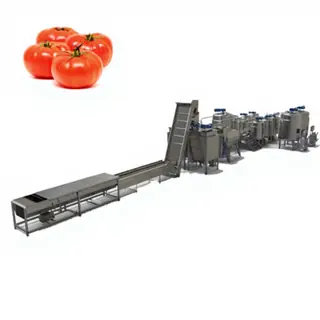
A tomato paste line receives and washes fresh tomatoes, sorts out defects, chops and heats them (hot or cold break), removes skins and seeds in a pulper-refiner, concentrates the juice under vacuum in a multi-effect evaporator, then sterilizes and fills the paste aseptically into bags in drums or into cans.
The process looks simple, but yield, colour and consistency are decided by a few critical choices: break temperature, screen sizes, evaporator design and sterilizer settings. This guide explains each stage and the numbers behind capacity planning.
What brix levels define tomato paste?
Under US regulations (21 CFR 155.191), tomato paste must contain at least 24.0% tomato soluble solids; below that, from 8.0% to under 24%, the product is tomato puree. International trade mainly uses 28–30 °Brix and 36–38 °Brix paste, often with hot break or cold break specified.
| Product / grade | Soluble solids | Typical use |
|---|---|---|
| Fresh processing tomatoes | About 5–6 °Brix | Raw material |
| Tomato puree (21 CFR 155.191) | 8.0% to under 24.0% | Sauces, soups |
| USDA "light" paste | 24% to under 28% | Retail cans |
| USDA "medium" paste (includes 28–30 °Brix trade grade) | 28% to under 32% | Ketchup, sauces, re-packing |
| USDA "heavy" paste (includes 36–38 °Brix trade grade) | 32% to under 39.3% | Bulk export, dilution by re-packers |
| USDA "extra heavy" paste | 39.3% or more | Specialty bulk |
What are the steps in tomato paste processing?
The main steps are receiving and flume unloading, washing, sorting, chopping, hot or cold break, pulping and refining, evaporation, sterilization and aseptic filling. Each stage either protects yield or protects quality, and the line is only as fast as its evaporator.
- Receiving and unloading: trucks are unloaded with water into flumes, which cushion the fruit and begin washing.
- Washing: roller or bubble washers with clean-water spray rinse remove soil, leaves and stones.
- Sorting: manual or optical sorting removes green, mouldy and damaged fruit, which would lower colour and raise mould counts.
- Chopping and break: fruit is crushed and immediately heated to control pectin-degrading enzymes (see below).
- Pulping and refining: rotating-paddle pulpers and finishers separate skins and seeds through progressively finer screens; screen size sets paste texture.
- Evaporation: the juice is concentrated under vacuum from about 5 °Brix to 28–38 °Brix.
- Sterilization and aseptic filling: paste is heat-treated, cooled and filled into pre-sterilized aseptic bags, commonly in drums or bins, or hot-filled into cans.
What is the difference between hot break and cold break?
Hot break heats crushed tomatoes quickly to above about 80 °C (up to roughly 95 °C) to inactivate pectin-degrading enzymes, giving thick, high-viscosity paste. Cold break uses lower temperatures, around 60–70 °C, letting enzymes act briefly for better colour and fresh flavour but lower consistency.
| Factor | Hot break | Cold break |
|---|---|---|
| Break temperature | Above about 80 °C, up to about 95 °C | About 60–70 °C (some definitions: below 60 °C) |
| Pectin enzymes | Inactivated quickly | Partly active before inactivation |
| Viscosity / consistency | High (thick paste) | Lower |
| Colour and fresh flavour | Good | Better |
| Typical uses | Ketchup, sauces, products diluted by customers | Juice, soups, light sauces |
The key to an effective hot break is speed: the chopped fruit must reach break temperature almost instantly, which is why break systems recirculate hot juice and chop directly into it.
How much fresh tomato is needed per tonne of paste?
Divide the paste brix by the fresh-tomato brix and allow for losses in sorting and refining. At 5 °Brix fruit, 28–30 °Brix paste needs about 6 tonnes of tomatoes per tonne, and 36–38 °Brix paste needs about 7.5–8 tonnes.
The calculation is a soluble-solids mass balance. Example for a line rated at 500 tonnes per day (TPD) of fresh tomatoes at 5.0 °Brix, with about 5% losses to skins, seeds and rejects:
- Juice to evaporator: 500 × 0.95 = 475 t/day containing 23.75 t of soluble solids.
- Paste at 29 °Brix: 23.75 ÷ 0.29 = about 82 t/day.
- Water to evaporate: 475 − 82 = about 393 t/day, or about 17.9 t/h over 22 operating hours.
| Fresh tomatoes | 28–30 °Brix paste | 36–38 °Brix paste |
|---|---|---|
| 100 t/day | about 16 t/day | about 13 t/day |
| 500 t/day | about 82 t/day | about 64 t/day |
| 1,000 t/day | about 164 t/day | about 128 t/day |
Real yields vary with variety and season: University of California variety trials report processing tomato averages of about 5.3–5.5% soluble solids, with individual varieties from about 4.9% to 6.0%. Every 0.5 °Brix difference in the field changes paste output by roughly 10%, so buyers should size the evaporator for the lowest expected brix.
Which evaporator and sterilizer suit tomato paste?
Tomato paste is concentrated in multi-effect vacuum evaporators with forced circulation, because rising viscosity makes natural or falling-film flow unreliable at high brix. A forced-circulation finisher handles the final effect, and the paste is then sterilized in a tubular or scraped-surface unit before aseptic filling.
In a forced-circulation evaporator, a pump drives product through the heater under pressure so boiling happens in the separator rather than on the tubes, reducing fouling. Multiple effects reuse vapour to cut steam use, and vacuum keeps boiling temperatures low to protect colour. Because tomato paste is an acidic product, commercial sterility is reached at lower temperatures than for low-acid dairy, but the exact time–temperature must be validated for your product and filler.
Which quality parameters should a tomato paste line monitor?
Monitor soluble solids (°Brix) by refractometer at the evaporator outlet, consistency (commonly by Bostwick consistometer on diluted paste), colour, pH, and mould and microbial counts. These parameters determine the commercial grade and price of the paste and confirm that break, refining and sterilization are working.
- Brix: measured continuously or every few minutes so the evaporator discharge valve holds the target grade.
- Consistency: mainly set by break temperature and screen size; hot break and finer refining raise it.
- Colour: protected by thorough sorting, short heat exposure and low evaporation temperatures under vacuum.
- Mould and defects: controlled at sorting; the USDA grade standards score defects and colour alongside soluble solids.
- Sterility: verified by incubation tests on filled aseptic bags or cans before release.
Recording these values batch by batch also gives the data needed to fine-tune break temperature and evaporator settings over the season.
Points to specify when buying
- Daily fresh-tomato intake and season length, and the lowest expected field brix.
- Product grade (hot or cold break, 28–30 or 36–38 °Brix) and screen sizes.
- Evaporator effects, steam pressure and cooling-water temperature available.
- Aseptic bag size and packaging format, or can sizes for hot fill.
- CIP for the break system and evaporator, which foul the most.
When we engineer a tomato line, we balance the break system, refiner and evaporator to the same hourly solids flow, so the evaporator never waits for juice and the break tank never overflows. If you send your daily tonnage and target brix, our engineers can return a preliminary mass balance and equipment list.
Frequently asked questions
What brix is tomato paste?
In the US, tomato paste must contain at least 24% tomato soluble solids. Commercially traded paste is mostly 28–30 °Brix or 36–38 °Brix. Products from 8% to under 24% soluble solids are classed as tomato puree.
How many kilograms of tomatoes make 1 kg of tomato paste?
With tomatoes at about 5 °Brix and around 5% processing losses, about 6 kg of fresh tomatoes make 1 kg of 28–30 °Brix paste, and about 7.5–8 kg make 1 kg of 36–38 °Brix paste. Higher-brix fruit reduces the ratio.
Is hot break or cold break better?
Neither is universally better. Hot break, above about 80 °C, gives thicker paste preferred for ketchup and sauces. Cold break, around 60–70 °C, gives better colour and fresh flavour with lower viscosity, suited to juice and soups. Choose based on your customers' specifications.
Why is tomato paste filled aseptically?
Aseptic filling lets sterilized paste be packed into pre-sterilized bags in drums or bins without further heating in the package. It preserves colour and flavour, allows ambient storage and shipping, and lets re-packers dilute the paste later into sauces and ketchup.
Sources
- eCFR – 21 CFR 155.191 Tomato concentrates
- USDA AMS – United States Standards for Grades of Canned Tomato Paste
- UC Cooperative Extension – Statewide Processing Tomato Variety Evaluation Trials (2005 report)
- Srichantra, A. (2002) Modeling of the break process to improve tomato paste production quality, Massey University
- GEA – Forced circulation evaporator